Battery System Economics: A review of how and why Battery Solutions are saving customers money
Battery energy storage systems (BESS) are helping organizations lower electricity costs by storing low-cost energy during off-peak hours and using it during periods of high demand, while also providing reliable backup power during outages and grid disruptions.
Authored by Ryan Smith | Renewable Program Specialist
The Rise of Battery Energy Storage Systems (BESS)
Some of the positive solutions resulting from an ever-strained, ever-changing grid are the emerging technologies being implemented to serve our electrical needs. An increasingly popular example of this is Battery Energy Storage Systems (BESS). These solutions are being deployed to help maintain power throughout the day, when demand begins to rival our supply. Large end-user customers are finding success deploying BESS on their own sites to not only aid in balancing their local grid, but also in high-yield energy cost savings.
One of the main benefits of a BESS is the possession of backup power in times of need. When power goes out, most industries have a need to keep the lights on- whether it be manufacturers, schools, hospitals, etc. This doesn't have to be the tropical storm induced event. We are witnessing more "brown-out" events across the country, categorized as intermittent outages that can disrupt operations. The ability to switch to on-site backup power is instantaneous with a battery, keeping lights on and business as usual.
Understanding Electricity Price Fluctuations
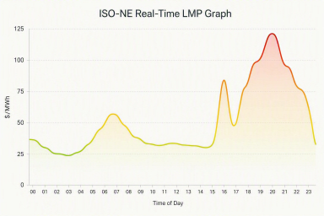
Aside from the elasticity offered by a BESS, there are clearer financial benefits which may be underappreciated. It is important to first acknowledge the daily fluctuation of electricity prices. In ISO-NE, there are 'spot prices' that represent a live, ever-changing cost of electricity. Over the course of the day, as demand ebbs and flows, prices follow suit. See the graph below for a visual.
How Battery Storage Creates Cost Savings
When the trendline is green, often in the early hours of the morning or during the day while people are away at work, energy is inexpensive. At peak hours of human activity, when the population is waking up and more so when the population returns home from work, we see the increase in demand translate to higher prices.
A BESS is a tool to create savings from these shifting energy rates. During the day, or overnight (cheap energy), the battery can pull power from the grid at low rates. Then, during peak hours where energy comes at a premium, your meter can switch to using power stored in the battery instead of using the ‘expensive’ power. Building managers don’t need to be hands-on for this process to keep up. BESS systems are integrated to optimize these switches instantaneously, without delay. Once installed, they will do their work for you.
Battery Storage Benefits Beyond Utility-Scale Projects
Discourse on battery systems has been largely focused on utility-scale projects; however, this is a technology that can be the source of numerous benefits in the public and private sectors alike. The best way to learn more is to talk to your energy advisor and discuss whether your site would be a good fit for a potential system.
Meet the Writer

Ryan Smith
Renewable Program Specialist
Freedom Energy Logistics
Ryan Smith is a Renewable Program Specialist at Freedom Energy Logistics, where he focuses on helping clients achieve their sustainability and clean energy goals. With experience in energy advisory and renewable program development, Ryan supports clients with solutions including clean energy plans, battery storage, and carbon-neutral strategies. His economics background and strong client-focused approach ensure that clients receive tailored energy solutions aligned with their environmental and financial objectives.





Connect With Us