
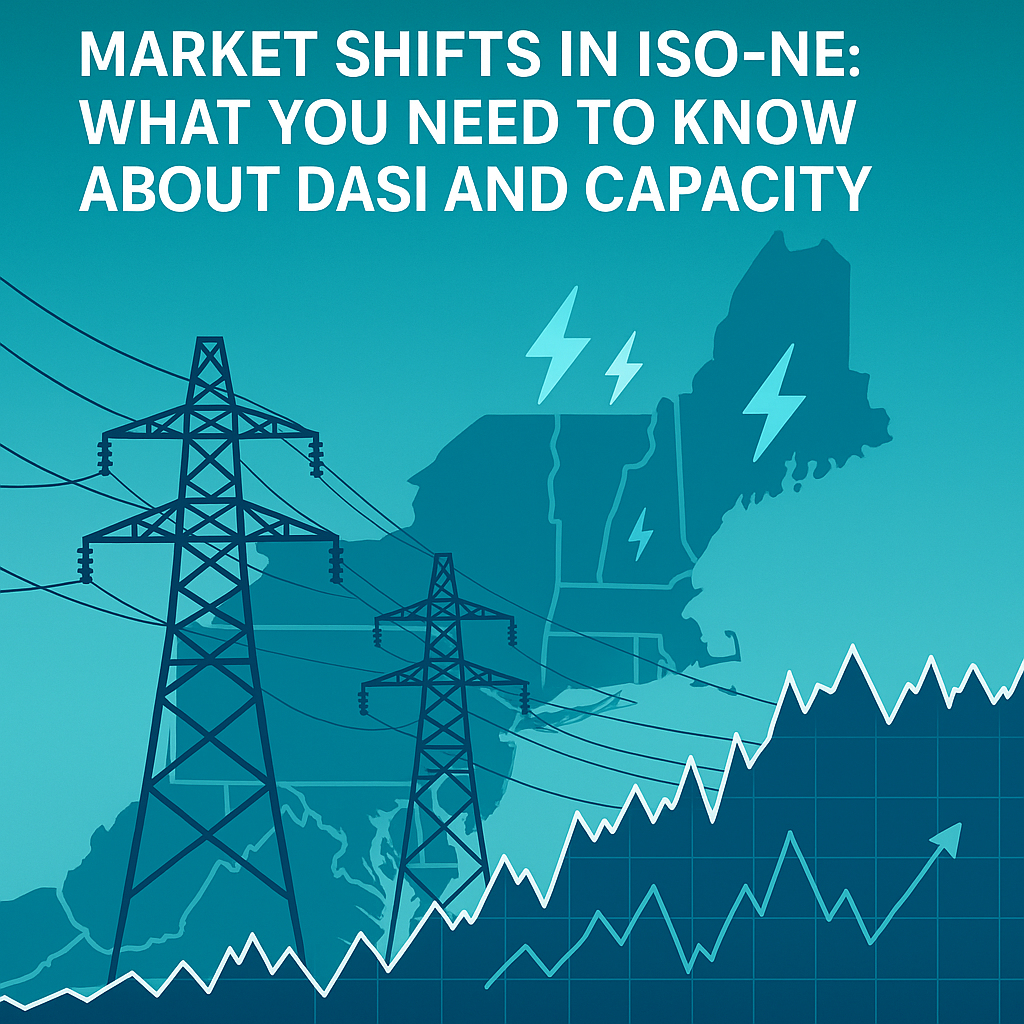
Market Shifts in ISO-NE: What You Need to Know About DASI and Capacity
Market Shifts in ISO-NE: What You Need to Know About DASI and Capacity
Twenty years ago, energy risk looked very different. Suppliers bore the brunt of volatility, with retail fixed rates composed of 60–70% commodity costs. Fixed-rate contracts were the norm—and the rate you signed was the rate you paid. Fast forward to today, and the landscape has shifted dramatically. Retail fixed rates now reflect just 35–45% commodity, and contracts are riddled with adjustments. The rate you sign is often just a starting point.
As the market evolves, two major changes in ISO-NE are reshaping how customers experience pricing: DASI and capacity.
DASI: From Fixed to Fluid
The introduction of DASI (Day-Ahead Ancillary Service Initiative) has transformed what was once a predictable, fixed cost into a monthly moving target. And with no historical data from a DASI winter, load-serving entities are left guessing how to price this component effectively.
Many customers have already felt the impact through rate increases. Others are grappling with how to incorporate DASI into future contracts. Should you hedge the cost for a premium, true it up annually, or pass it through entirely? The answer depends on your billing method—Dual vs. Utility Consolidated Billing (UCB)—and your organization's budget tolerance.
Capacity: A New Era of Pricing Dynamics
ISO-NE's capacity market is also undergoing a major overhaul. By 2028, the region will shift from forward auctions to prompt auctions, introducing two seasonal commitment periods: summer and winter. This change will make capacity pricing more responsive and accurate—but also more variable.
Industries with heavy winter loads, which previously benefited from the current system, may feel the pinch first. However, with ISO-NE projected to become a winter-peaking grid by 2032, this shift was inevitable. The new structure aims to better reflect real-time demand, but customers should prepare for a more dynamic—and potentially volatile—pricing environment.
Planning Ahead: What Customers Can Do Now
To navigate these changes, customers should take a proactive and strategic approach. Here are key steps to consider:
- Understand Your Load Profile
- Analyze your seasonal usage patterns to determine how winter peaking trends and capacity shifts may affect your costs.
- Industries with high winter demand should prepare for increased exposure.
- Review Your Billing Method
- Dual billing vs. UCB can significantly impact how DASI and capacity costs are passed through.
- Work with your energy advisor to understand which billing structure aligns best with your risk tolerance and budget strategy.
- Evaluate Hedging Strategies
- Consider partial hedging for volatile components like DASI to balance predictability with flexibility.
- Full pass-through may offer transparency but could expose you to monthly price swings.
- Build Budget Scenarios
- Create multiple budget forecasts based on different market outcomes (e.g., mild vs. severe winter).
- Include contingency buffers to accommodate unexpected spikes in DASI or capacity charges.
- Engage in Contract Design
- Customize your energy contract to reflect your operational needs and financial goals.
- Ask about clauses that allow for mid-term adjustments or re-pricing mechanisms.
Turning Volatility Into Opportunity
The energy landscape is evolving rapidly. While uncertainty can be daunting, it opens the door to smarter, more tailored energy strategies. By understanding your risk profile, leveraging flexible contract structures, and staying ahead of market trends, you can turn volatility into opportunity.
Want help building a future-ready energy plan? Contact Us
Meet the Writers

Carol Anne Watts
Freedom Energy Logistics
Vice President of Sales
Carol Anne Watts has over 15 years of experience in the energy industry, shaping energy sales since 2006. As the VP of Sales, she leads the sales team, drives targeted strategies, and excels in client relationship management.






Connect With Us