March 2026 NH Muni Minute
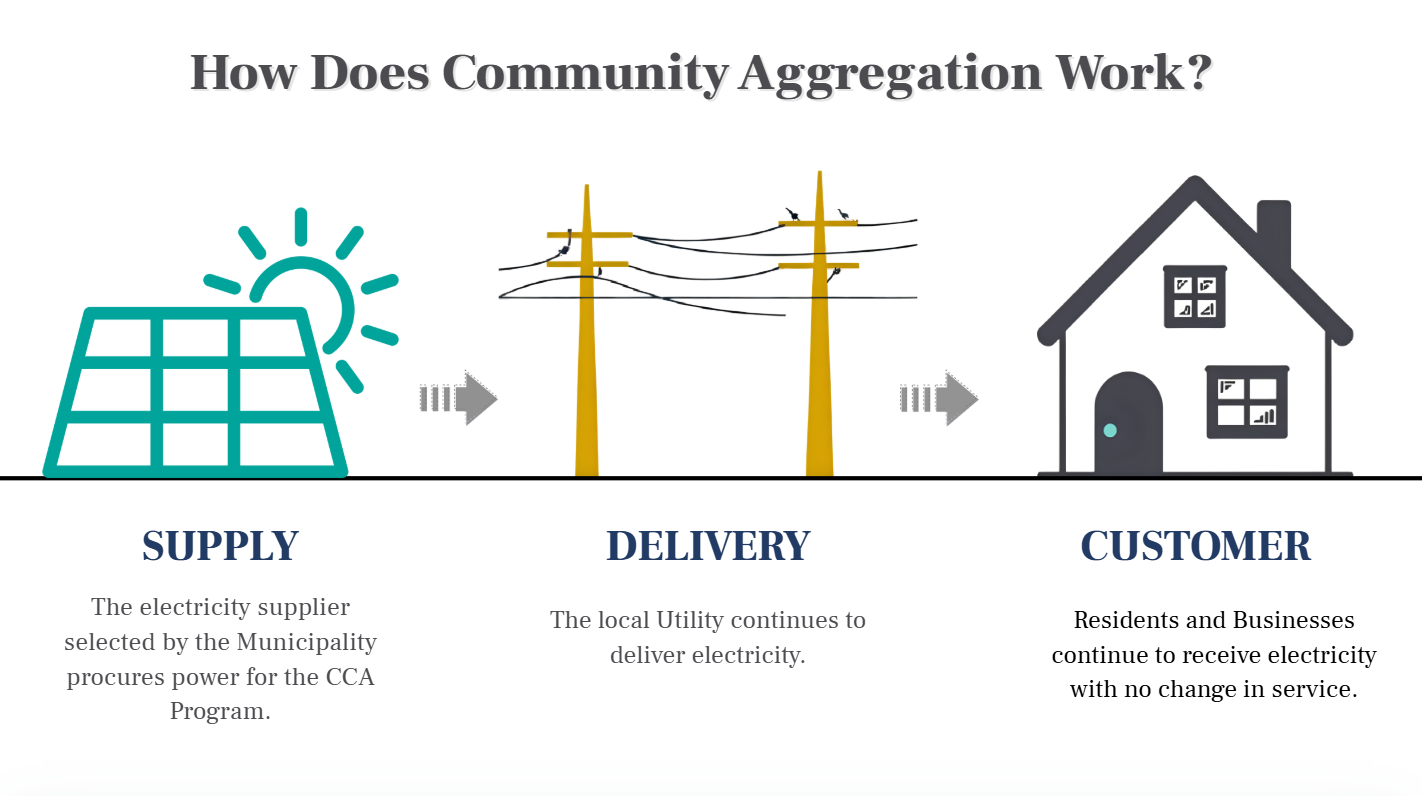
Community Choice Aggregation (CCA) gives cities and towns the ability to combine the purchasing power of residents and small businesses to secure competitive electricity supply rates and greater control over energy choices. While the local utility continues to deliver electricity, maintain infrastructure, and send the bill, the municipality can choose a supply program designed around affordability, transparency, and community priorities.
For New Hampshire communities, CCA offers a practical path to stronger local control in an increasingly volatile energy market. Instead of leaving residents exposed solely to changing default utility rates, municipalities can explore contracts that better align with local goals, whether that means near-term savings, longer-term rate stability, or additional renewable energy options. CCA also helps communities create a more informed public dialogue around electricity supply and procurement.
Another key benefit is flexibility. Residents who are automatically enrolled in a CCA program may generally opt out without fees or penalties, and customers already with a third-party supplier are typically unaffected unless they choose to participate. This structure helps preserve consumer choice while enabling the town or city to leverage aggregation for broader public benefit.
As more New Hampshire municipalities move from planning to implementation, CCA is becoming an increasingly important tool for managing electricity costs, supporting long-term energy strategy, and giving communities a larger role in shaping their energy future. Freedom Energy continues to work with towns and cities across the state to help design and implement CCA programs that reflect local needs and market realities.

Salem’s Community Choice Aggregation program marked a major milestone for the town when it launched in November 2025, offering residents and small businesses access to a competitive electricity supply rate of $0.11180 per kWh through an agreement with First Point Power. At launch, that rate came in below Liberty’s default winter rate of $0.124 per kWh, through February 2026 and continues to remain competitive when compared with Liberty’s current six-month default supply rate of $0.13735 per kWh (2/1/26-7/31/26).
The initial rate difference translated into meaningful savings for the town. In the first three months alone, Salem’s program was projected to generate nearly $825,000 in community savings, demonstrating the value that aggregation can deliver when pricing is secured strategically. Beyond the savings, the program also gave Salem residents more visibility into their electricity options while maintaining the simplicity of staying with Liberty for delivery, billing, and outage response.
Salem’s CCA also reflects a broader community value proposition. By pairing cost savings with stability and local oversight, the town positioned its energy program as another quality-of-life benefit for residents and businesses. The program continues to serve as a strong example of how New Hampshire communities can use CCA not just as a procurement tool, but as part of a longer-term affordability and resilience strategy.
With Salem helping lead the way, the town’s experience offers a useful roadmap for other municipalities evaluating whether CCA can support their own energy and budget goals.

Beginning April 1, 2026, Merrimack residents on electric default service will be able to participate in the town’s new Community Choice Aggregation program at a rate of $0.09699 per kWh through October 31, 2026. The program’s electricity supplier is First Point Power, and the rate compares favourably to Eversource’s default supply rate of $0.11303 per kWh effective February 1 through July 31, 2026.
That difference of $0.01604 per kWh represents a meaningful short-term savings opportunity for Merrimack households and small businesses. Town leaders have emphasized that the program is intended not only to reduce costs, but also to improve affordability, transparency, and local control over energy decisions during a period of continued regional price volatility.
Merrimack’s program has been years in the making. The Town Council approved the final plan in July 2024 and selected Freedom Energy to oversee implementation. As part of the rollout, Merrimack and Freedom Energy scheduled an information session to help residents better understand the new program, their enrollment options, and how CCA works alongside utility service.
Importantly, customers enrolled in the program will continue to receive delivery and billing services from Eversource, and they may opt out at any time without fees or penalties. This structure allows Merrimack to leverage collective purchasing power while preserving consumer choice and maintaining a familiar customer experience.

The Town of Londonderry is preparing to launch its first Community Choice Aggregation program on April 1, 2026, giving eligible residents on Eversource default service access to a supply rate of $0.09573 per kWh through an agreement with First Point Power. Compared with Eversource’s six-month default rate of $0.11303 per kWh, Londonderry’s initial CCA rate offers savings of $0.0173 per kWh.
The launch represents a significant step forward for the town, which has worked for years to bring the program to fruition. Town officials highlighted the CCA as an opportunity to improve affordability, provide more competitive electricity pricing, and enhance local oversight in energy management. In a market that has seen considerable price volatility, Londonderry’s new program gives residents and small businesses an alternative designed to provide both immediate value and better long-term stability.
As part of the rollout, the Town and Freedom Energy hosted an information session to help educate residents about the program and the enrollment process. Eligible customers received mailed notices in February and had the option to opt out prior to enrollment. Those already receiving electricity from a third-party supplier or with residential solar arrays are not automatically enrolled, though they may have opportunities to opt in after reviewing their current supply agreement.
Like other CCA programs, Londonderry participants remain Eversource customers for electricity delivery, metering, outages, and billing. That means the town can offer an alternative supply solution without disrupting core utility service.

The City of Laconia and Freedom Energy announced that beginning April 1, 2026, residents and small business owners on electric default service can join Laconia's Community Choice Aggregation program at $0.10286 per kWh through October 31, 2026. Direct Energy Services, LLC will serve as the electricity supplier for the program.
Laconia's CCA rate comes in below Eversource's current default supply rate of $0.11303 per kWh, providing an opportunity for savings for participating residents and small businesses.
City leaders have framed the new CCA as an opportunity to collectively purchase electricity more strategically while providing more stable and competitive pricing for the community. The program follows public hearings and City Council approval, reflecting a deliberate planning process aimed at improving affordability, transparency, and local energy choice.
Residents will continue to receive delivery and billing from Eversource, and those automatically enrolled in the aggregation program may still opt out at any time without fees or penalties. Customers already using a third-party electricity supplier will not be automatically affected.
Freedom Energy currently supports Community Choice Aggregation programs in 12 New Hampshire communities, and as one of several municipalities launching CCA programs this spring, Laconia adds further momentum to the state's growing aggregation landscape.
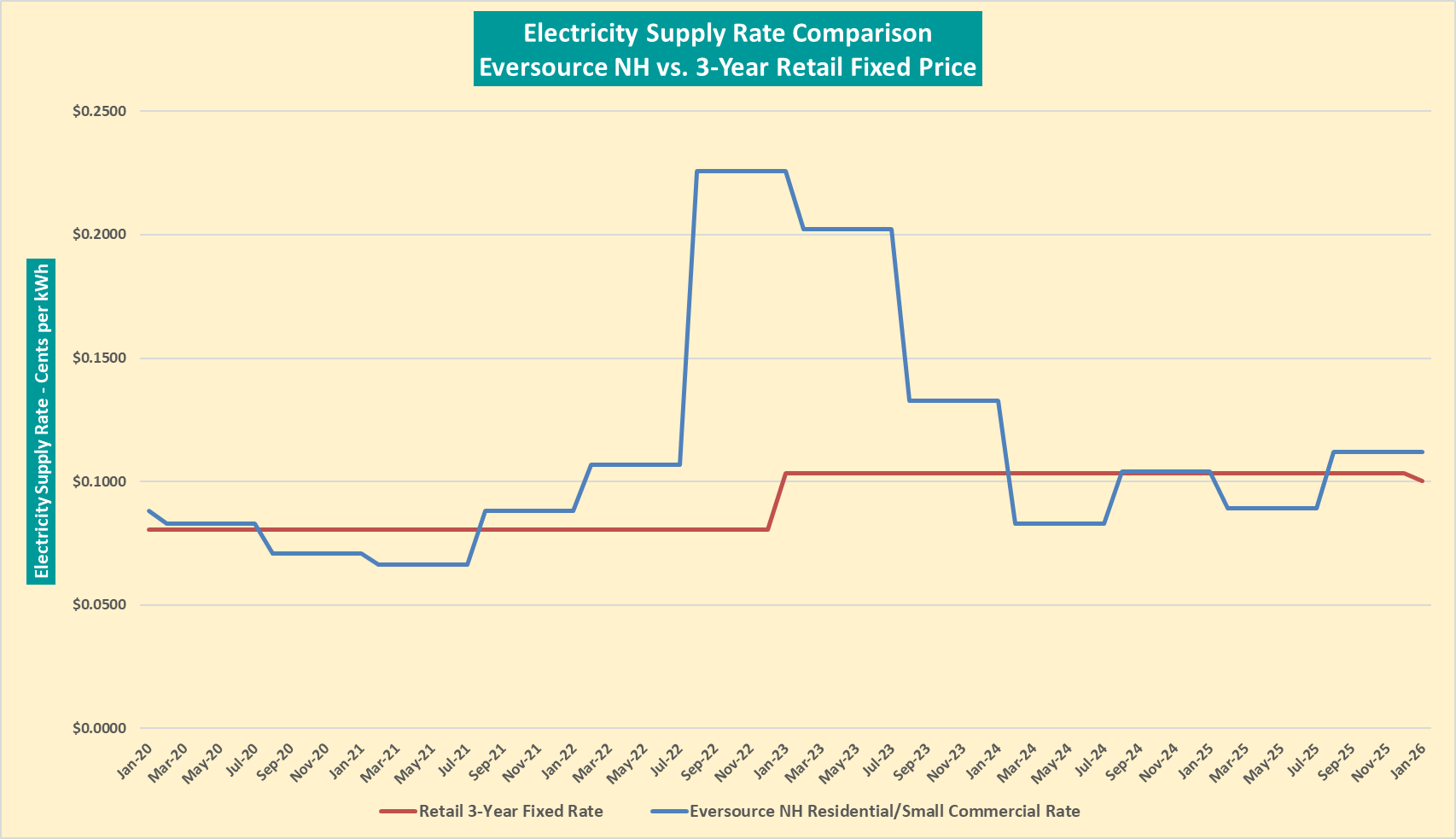
Beyond the Six-Month Cycle: Why Longer-Term CCA Contracts Can Deliver More for New Hampshire Communities
As Community Choice Aggregation expands across New Hampshire, one strategic question is becoming increasingly important: how long should a municipality lock in its electricity supply contract? While many communities have traditionally followed the utility model of six-month supply terms, longer-term CCA contracts may offer a stronger path to stability and long-term value.
In his recent New Hampshire Municipal Association article, Bart Fromuth, CEO of Freedom Energy, explains that short-term contracts can leave communities exposed to the same market volatility as utility default service. When electricity prices rise due to fuel market shifts, weather events, or broader geopolitical pressures, towns on short contract cycles may have limited protection. By contrast, longer-term contracts can provide more budget certainty, smoother pricing, and better opportunities to lock in favourable market conditions when they arise.
Recent New Hampshire examples help illustrate the point. Hampton secured an 18-month contract and later moved to a three-year agreement, while Salem launched with a two-year contract around 11 cents per kWh. These longer-duration agreements can help municipalities reduce the frequency of exposure to changing utility rates while offering residents more predictability over time.
The article also points to Massachusetts, where most CCA programs run contracts between one and three years and where a large majority of programs have historically achieved savings compared with utility default service. For New Hampshire municipalities, the takeaway is not that short-term contracts have no place, but that towns should think more strategically about how contract duration aligns with their broader goals around savings, stability, and risk management.
As the state's CCA market matures, contract length is likely to play a larger role in how communities evaluate success. Used thoughtfully, longer-term contracts can help municipalities strengthen affordability, improve planning confidence, and create more resilient local energy programs.

As more municipalities in New Hampshire evaluate or refine their Community Choice Aggregation programs, implementation strategy matters. Freedom Energy’s approach is built around flexibility, local control, and active market participation giving communities more tools to shape a program that reflects their own priorities.
One differentiator is supplier access. Rather than limiting communities to a single supply source, Freedom works with multiple suppliers to foster competitive bidding and create more options around pricing and contract structure. That broader market access can help communities pursue more favorable rates while reducing dependence on a one-size-fits-all model.
Freedom also emphasizes customization. Communities can work with Freedom to evaluate contract length, pricing structure, renewable options, and risk management in a way that aligns with local goals. Some towns may prioritize immediate savings, while others may place greater value on longer-term rate stability or the inclusion of renewable energy attributes. A flexible framework makes those choices easier to evaluate.
Another advantage is strategic purchasing. Freedom actively monitors energy markets and can help communities pursue contracts ranging from shorter-term arrangements to multi-year agreements when market conditions support them. This can create opportunities to secure better timing on supply purchases and position communities for greater stability beyond the default utility cycle.
Finally, Freedom’s model allows participating communities to explore added long-term value creation. Combined with municipal support, market insight, and customer choice, this approach is designed to help towns and cities use CCA not just as a supply alternative, but as a broader community energy strategy.






Connect With Us