September 2025 NH Muni Minute
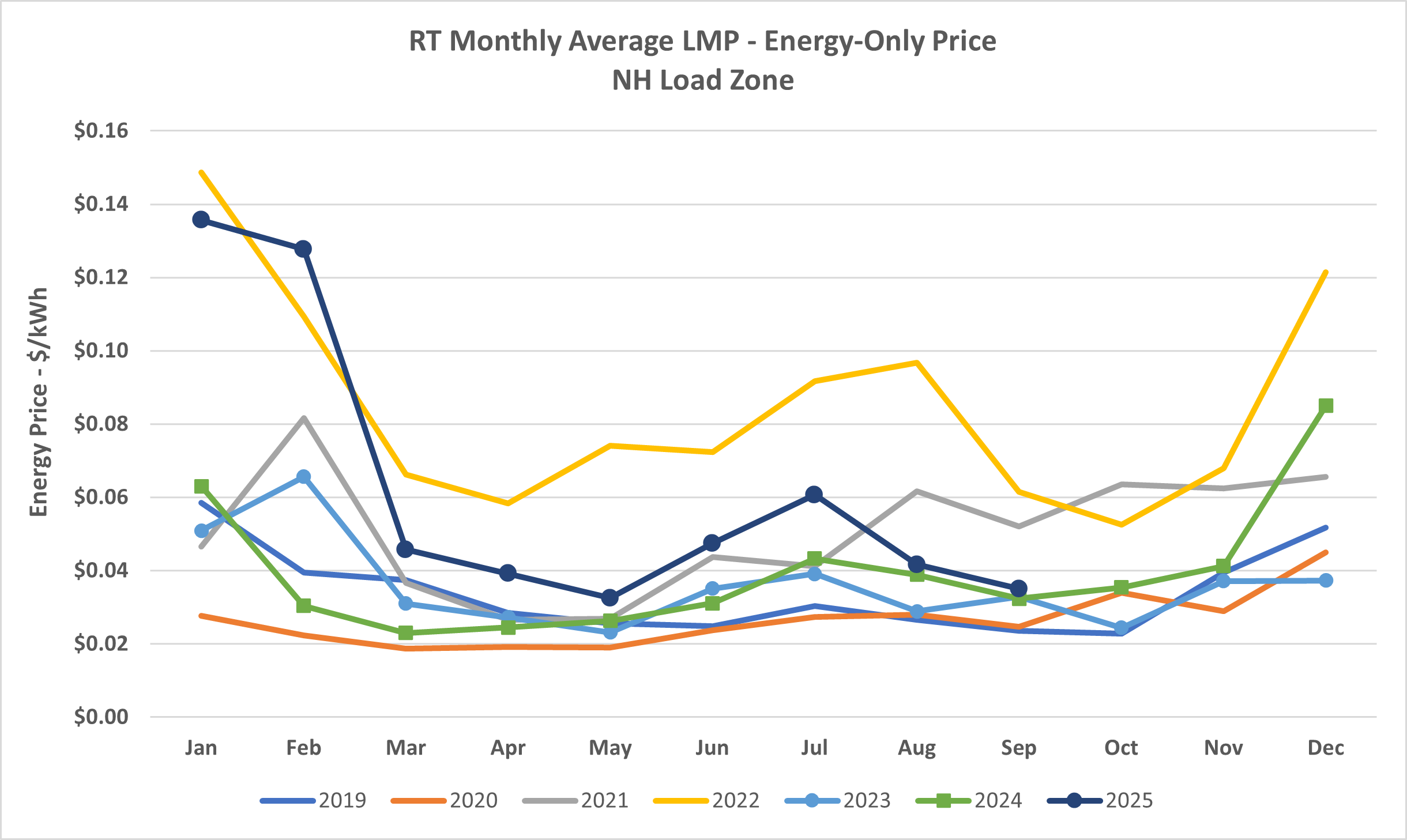
Summer 2025 brought dramatic but short-lived energy market fluctuations in New England. After a mild spring with wholesale electricity averaging 3.3 cents per kWh, a late-June heatwave sent prices soaring to 15.8 cents for the June 23–25 period. By August 31, prices had stabilized at 5.1 cents per kWh and averaged 3.5 cents during the first two weeks of September.
Behind-the-meter solar played a significant role in moderating prices, with 5,000–6,000 megawatts reducing mid-day load by 20–25%. This distributed generation helped offset demand spikes and demonstrates the growing importance of local energy resources.
Futures markets reflected these shifts as well. The 2026 electricity futures contract fell from 6.8 cents in late June to 6.4 cents by early September, while 2027 and 2028 futures moved in the opposite direction, rising by 0.8 cents. Natural gas futures mirrored the pattern, with 2026 contracts dropping from $4.468 per dekatherm on June 20 to $3.848 by September 12, even as prompt-month gas hit its high point back in March.
This convergence of electricity and natural gas pricing underscores how closely the two markets are linked. For policy makers, municipalities, and large users alike, it’s a reminder that even short-term weather events can ripple across the region’s energy costs. Staying informed about futures trends helps communities anticipate and manage budget impacts. Freedom Energy’s team continues to monitor these dynamics to provide actionable insights for clients heading into the 2026–2028 planning horizon.
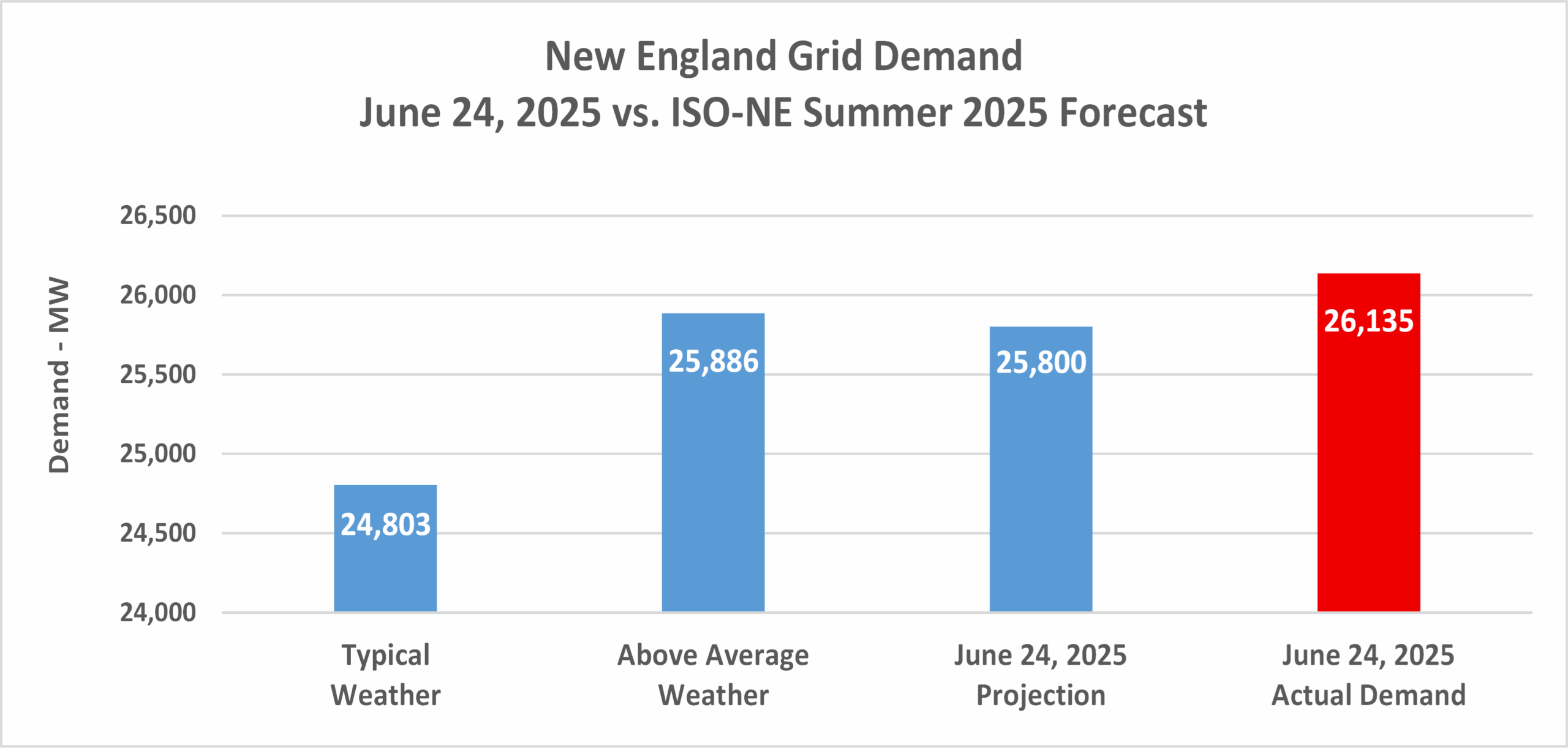
On June 24, 2025, New England experienced its highest electricity demand since 2013, peaking at 26,135 MW during a four-day heatwave. Eight days earlier, the region had anticipated January 21 as the likely peak, but extreme summer weather shifted the outcome. This year marked the first time since 2009 that Freedom Energy issued only a single curtailment notice — a stark contrast to the seven sent during the 2024 season.
ISO-NE responded with a series of emergency measures to maintain grid reliability. Demand response resources were activated, emergency capacity purchases were considered, and exports to neighboring regions were curtailed. In total, 2,550 MW of generating capacity became unexpectedly unavailable, reducing reserves and prompting a capacity deficiency alert at 5:50 pm.
Wholesale electricity prices surged dramatically between 5:30 and 6:00 pm, reaching close to $1,600/MWh and averaging $240/MWh for the day — far higher than the 2025 year-to-date average of $63/MWh. This event underscores the growing volatility of summer peaks and the importance of proactive curtailment programs.
Looking forward, ISO-NE expects system peaks to continue evolving. With electrification driving winter demand, future peaks may occur outside traditional summer months. Beginning June 1, 2028, the Forward Capacity Market will split into two seasonal auctions to reflect winter and summer periods. This change will effectively set capacity tags twice a year and may necessitate sending curtailment notices for both seasons.
Freedom Energy continues to track these developments closely, helping clients understand their exposure to capacity costs and the opportunities to lower them through curtailment strategies and energy efficiency programs. If you’d like to receive our peak notifications in the future, sign-up here.

Father and son team manage Freedom Energy Logistics together.
Father and son team manage Freedom Energy Logistics together. In the August edition of Business NH Magazine, Freedom Energy was listed among the top family-owned businesses in New Hampshire. According to the publication, "Family businesses are a key part of the NH economy, ranging from small shops to large retailers such as Walmart. To recognize this segment, Business NH Magazine compiles an annual list of the Top Family-Owned Businesses in NH. Family businesses statewide with annual revenue of $1 million or more are invited to complete a survey".
Bart Fromuth, CEO of Freedom Energy, and his father, Gus Fromuth, Founder and Managing Director of the Auburn, NH-based energy advisory, were profiled in the magazine. Gus Fromuth established the company in 2006, and Bart Fromuth became CEO in 2021. Freedom Energy remains family-owned, has about 40 employees, and is among New England's larger energy consulting companies, serving clients across the US, including California. The company maintains a regional office in Westborough, MA, and has been named to the Inc 5000 four times, including in 2024 and 2025. Read the full article here.

Buy Local — a slogan we hear when going to our favorite ‘Mom and Pop’ retail stores, or family-owned restaurants in town. Supporting communities has long been a cornerstone of the small-town experience in America. Can the same be said for the energy space?
New Hampshire is host to a diverse energy ecosystem. With long-standing hydro dams throughout the state, and newer solar arrays being strategically placed, there are new ways to support NH businesses in the grid.
When a hydro dam or solar array is larger than 1 MW it sells that power to the utility within which it resides (a 1MW solar array takes up roughly 2.5 football fields). The process of matching a utility account with an off-site generation asset is called virtual net metering. Moreover, the process of compiling numerous utility accounts together for a single off-site asset is called group net metering.
Every kWh of power generated and distributed throughout the utility territory is sold to the utility company. A percentage of that transaction is given to the owners of these “grouped” accounts.
So, there is no installation on your campus, there is no fee or cost — it is essentially a discount for buying local.
Many hydro dams in the state also rely on offtake support to keep turbines spinning and keep power flowing to the grid.
Right now, renewable generation between 1–5 MW is only eligible to be group net metered with political subdivision entities — towns, schools, public entities, etc. Sufficient support for the proposed Senate Bill 106 would open this opportunity to C&I as well as municipal customers.
The group net metering program in New Hampshire is not new. The first hydroelectricity production in the state dates to the 1920s and there are currently 24 plants over 1 MW that connect to the electricity grid (EIA State Profile Analysis, 2024).
New Hampshire has a fascinating energy profile to lean on, and perhaps the same ‘Buy Local’ saying that has kept New Hampshire so near to its values can be applied to energy transactions. If you’re interested in learning more about community solar or net metering opportunities, contact us.
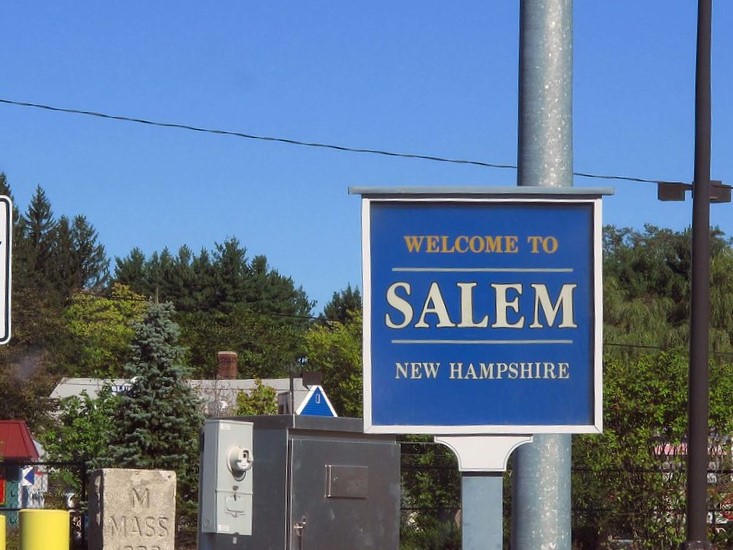
The Town of Salem, NH is taking a significant step forward in energy management announcing its first Community Choice Aggregation (CCA) program designed to benefit residents and small businesses. In partnership with Freedom Energy and CPG, Salem has entered into an agreement with First Point Power to secure a competitive CCA contract. Starting November 2025, Salem residents currently on default service will have access to the town’s new CCA rate of $0.11180 per kilowatt hour (kWh), which is notably lower than Liberty’s recently announced winter default rate of $0.124 per kWh.
This rate difference translates into substantial savings, with the community expected to save nearly $825,000 over the initial three months of the program. The CCA initiative not only offers financial relief but also positions Salem as a leader in affordability and energy choice. Town Manager Joe Devine expressed pride in the program, emphasizing its role in delivering real cost savings and enhancing the town’s reputation for transparency and forward-thinking energy solutions.
The rollout of the program included informational notices sent to Salem residents beginning in mid-September. Residents will have 30 days to opt out of the new CCA program if they choose; otherwise, they will be automatically enrolled and switched from Liberty’s default service. Importantly, those already using a third-party electricity supplier will remain unaffected, and aggregation customers will still be serviced and billed by Liberty for delivery and metering, ensuring continuity and simplicity.
To further assist the public in making informed decisions, Freedom Energy and the Town will host an informational session on Thursday, October 9, 2025. Additional resources and updates are available on the town’s website, the Salem CCA website, and at various public buildings throughout Salem. This collaborative effort marks a milestone for Salem, setting a precedent for energy programs across New Hampshire and reinforcing the town’s commitment to resilience and innovation. To learn more about Salem, NH’s CCA, read the full press release and visit Salem CCA page to learn more.
Find out more about how Community Choice Aggregation can benefit your community.
New Hampshire, August 12, 2025 – Inc. Magazine announced today that Freedom Energy Logistics (Freedom Energy) achieved the annual Inc. 5000 list of fastest-growing private companies in America—Freedom Energy’s fourth appearance (2017, 2018, 2024, 2025). The ranking offers a data-driven snapshot of the economy’s most dynamic businesses.
“Freedom Energy is excited to be recognized on the Inc. 5000 for the fourth time among the leading businesses,” said CEO Bart Fromuth. “Our continued growth reflects the excellence of our team, our steadfast dedication to client advocacy, and our investments in innovative and sustainable energy solutions as well as in our employees. We sincerely appreciate our team, strategic partners, clients, and community for their invaluable contributions.”
To read more click here.




Connect With Us