
Early Renewals and the Value of Looking Beyond the Next Contract Expiration
Early energy procurement can help organizations capture favorable future pricing, increase budget certainty, and reduce exposure to market volatility by acting before contract expiration.
Authored by Bart Fromuth | Chief Executive Officer
For many organizations, energy procurement remains a transactional exercise. A contract approaches expiration, pricing is requested from suppliers, proposals are evaluated, and a decision is made. While that approach is common, it often overlooks one of the most valuable tools available to energy buyers: time.
Some of the most successful procurement decisions we have helped clients make over the past several years were executed long before the underlying energy was needed. Rather than waiting for a contract expiration date to dictate their options, these organizations continuously monitored the market, evaluated opportunities as they arose, and acted when pricing represented value. Today, that strategy deserves renewed attention.
“The greatest procurement opportunities rarely occur when a contract expires.
They occur when the market offers value.”
— Bart Fromuth
A Market Sending a Clear Signal
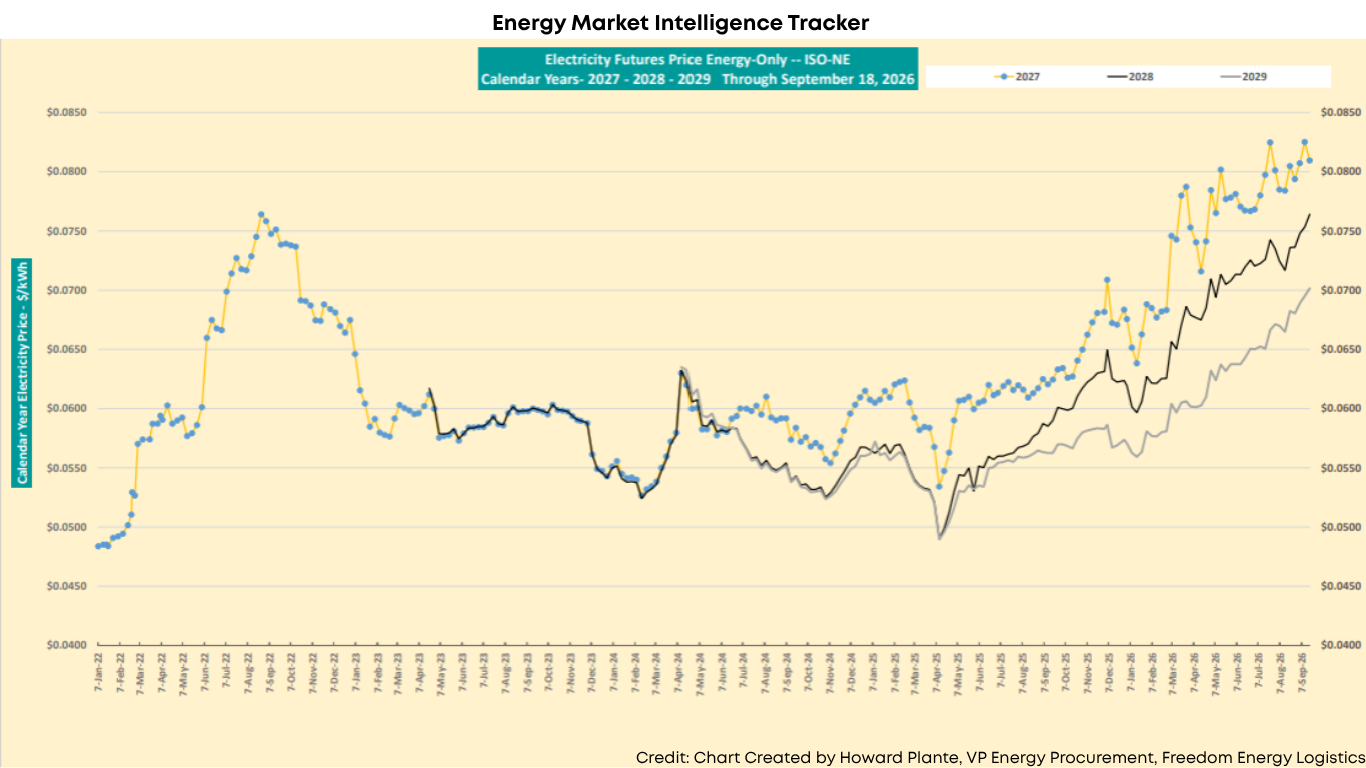
Anyone who has seen our Energy Market Intelligence Tracker charts knows why so many of our recent conversations have centered around future energy procurement. The forward power market in New England remains meaningfully backwardated. Put simply, electric power for 2028 and 2029 continues to trade below many of the nearer-term delivery periods. That should get people’s attention.
Markets do not often provide buyers with the opportunity to secure future requirements at prices below what they are paying for energy delivered sooner. While no market signal is perfect, the current forward curve presents a compelling opportunity for organizations willing to think beyond their next contract expiration date. More importantly, today’s pricing appears increasingly disconnected from the long-term fundamentals facing the New England electric grid.
Demand growth is accelerating. Electrification initiatives continue to expand. Data centers are growing. Transportation loads are increasing. Economic development remains a priority across the region. At the same time, New England is struggling to add new dispatchable generation resources at the pace necessary to support that growth.
The one resource category we have become exceptionally good at building is solar, and that deserves recognition. Ten years ago, summer afternoons represented some of the most challenging periods for grid operators. Today, solar generation has dramatically reduced many of those concerns. During summer peak periods, solar is doing exactly what policymakers hoped it would do by reducing demand on the grid and lowering reliability risks.
The challenge is that summer is no longer where New England’s greatest reliability concerns reside. Increasingly, those concerns are showing up during the winter. When temperatures fall, electricity demand rises. Solar production declines. Fuel constraints become more pronounced. Yet there are relatively few resources currently under development that can materially improve winter supply over the next several years.
That raises an important question for energy buyers: If demand continues to grow faster than winter supply, are today’s forward prices fully reflecting that risk? Many market participants would argue they are not.
Early Action Is Already Producing Results
Several Freedom Energy Logistics clients have already embraced a more proactive procurement strategy and are seeing the benefits. The Town of Salem, New Hampshire recently elected to secure 50% of its future Community Choice Aggregation load for a 2027 delivery start well ahead of the traditional procurement window. Since that hedge was placed, market prices have increased by more than one cent per kilowatt-hour, creating meaningful value relative to current market levels. The decision was not based on predicting where the market would be in the future. It was based on recognizing an attractive opportunity when it was available.
“We viewed this as an opportunity to secure value for Salem residents while also creating greater certainty around future program pricing. Waiting was not necessarily going to give us a better outcome, and we were comfortable acting when the opportunity presented itself.”
— Joe Devine, Town Manager, Town of Salem
Epping SAU signed its electricity contract in October 2024 for a December 2027 start. By acting more than three years before delivery, the district avoided major subsequent market moves and secured a very favorable position for the 2027 through 2029 period.
“Our partnership with Freedom Energy Logistics has provided tremendous value to the Epping School District. By strategically securing our electricity rates when market conditions were favorable, we have been able to achieve meaningful savings while also bringing greater predictability to our annual budgeting process.
After a successful contract covering 2024–2027, we recently committed to a new agreement for 2027–2029. In a school district, where responsible stewardship of taxpayer dollars is so important, having the ability to better anticipate energy costs and protect the budget from market fluctuations is incredibly valuable.
Freedom Energy Logistics has helped us approach energy purchasing proactively rather than reactively, allowing us to lock in favorable rates and plan with greater confidence.”
—Christine Vayda, Business Administrator, Epping School District
South Essex Sewerage District provides another excellent example. The organization first secured power for a 2025 renewal in early 2024, and then returned to the market this summer to take advantage of the current backwardation with a purchase for 2028 delivery.
“We try to always look for future opportunities. It just makes sense to explore extending a contract if there is backwardation in a climate of several years of steadily increasing energy prices.”
— David Michelsen, South Essex Sewerage District
This approach is not limited to governmental entities. A large food packaging manufacturer north of Boston executed its current electricity supply agreement in May 2025 for a late 2026 renewal extending through 2029. Like many sophisticated buyers, the company recognized that attractive pricing opportunities do not always occur when contracts are approaching expiration. Sometimes the best opportunities arise years earlier. What these organizations have in common is not that they predicted the future. It is that they recognized value when it presented itself.
Savings Are Only Part of the Story
When discussing early renewals, most people immediately focus on avoided costs. That is understandable. If future market prices rise after a contract is executed, the financial benefits can be substantial. However, focusing exclusively on savings overlooks another equally important benefit: budget certainty.
Municipal governments, school districts, manufacturers, wastewater authorities, and commercial businesses all operate within financial constraints. Knowing a major operating expense years in advance allows organizations to budget with confidence, improve long-term planning, and reduce exposure to unexpected market volatility. For many organizations, that certainty has significant value independent of whether the transaction captures the absolute lowest point in the market. In some cases, avoiding uncertainty can be just as important as maximizing savings.
Not Every Early Purchase Will Be Perfect
It is important to acknowledge that no procurement strategy succeeds 100% of the time. Markets can move lower after a contract is signed. Opportunities can be missed. Hindsight will always produce examples where waiting or acting sooner would have generated a better outcome.
The objective is not perfection. The objective is to identify opportunities where the probability of success is favorable relative to the associated risk.
Today, the combination of backwardated forward markets, accelerating demand growth, limited winter supply additions, and increasing concerns around long-term system reliability creates a particularly compelling environment for proactive buyers. That does not mean every organization should lock in every opportunity. It does mean every opportunity deserves evaluation.
Organizations that wait until a contract is approaching expiration are effectively accepting whatever market conditions exist at that moment. By contrast, organizations that continuously evaluate future requirements maintain the flexibility to act when attractive opportunities arise. That flexibility often becomes a competitive advantage.
Procurement Should Be a Process, Not an Event
Energy procurement is often viewed as an administrative task triggered by a contract expiration date. The most successful organizations view it differently. They treat procurement as an ongoing portfolio management function. They monitor the market. They evaluate opportunities. And when value presents itself, they act.
The experiences of Salem, Epping, South Essex Sewerage District, and other forward-thinking organizations demonstrate a simple but important lesson: Some of the most valuable procurement decisions are made years before the energy is ever consumed. In a market that continues to offer attractive pricing opportunities for future years despite mounting long-term supply concerns, that lesson may be more relevant today than ever before.
Meet the Writer

Bart Fromuth
Freedom Energy Logistics
Chief Executive Officer
Bart Fromuth, Chief Executive Officer at Freedom Energy Logistics, brings extensive experience in energy procurement, policy, and the New England energy market to his role. With a background as an Energy Attorney, he works closely with clients and energy suppliers to navigate complex energy markets, develop procurement strategies, and identify opportunities that support long-term energy goals.






Connect With Us