
2025 Massachusetts Municipal Update: Day-Ahead Ancillary Services, Increased Pipeline Capacity Costs & Another Successful Year for Freedom Clients!
Authored by Brian White | Municipal Program Director
Market Volatility Continues into 2026
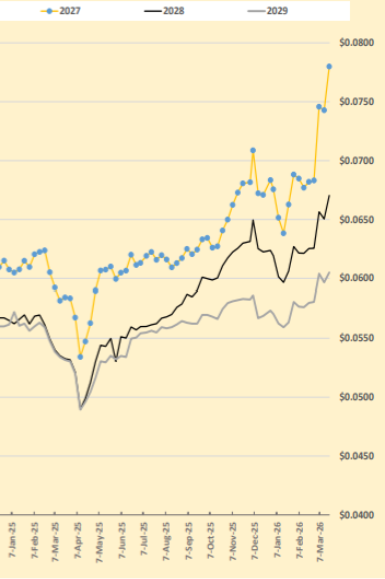
In the past three years, electric and natural gas forwards were volatile. After hitting a low point in April, energy forwards went on an upward trajectory to finish the year, and the start of 2026 has not shown any change.
Change in Law Impacts on Budgets
There were also two significant "Change in Law" situations that allowed electric and natural gas suppliers serving Massachusetts' cities and towns, to increase your fixed rate mid-term, causing problems with existing FY26 budgets. Change in Law pass throughs are becoming more common, as if the state does not want to acknowledge its insane energy prices and instead implement "new" charges to explain away high electric and gas rates. Regardless of the reason(s), these swings create opportunity and indigestion for energy buyers.
Electric Market Shift: DASI Implementation
Electric Change In Law – Day-Ahead Ancillary Services Initiative (DASI): Massachusetts launched DASI in March 2025, creating a new market structure to procure and compensate ancillary services – such as reserves and regulation – on a day-ahead basis to strengthen grid reliability, support renewable integration, and incentivize flexible resources like storage and fast ramping generators. This added charge was passed through to the end user by electric suppliers, starting in June 2025, causing your fixed rate to increase because of a "Change in Law". DASI replaced the Forward Reserve Market in Massachusetts, and this change affects all electric customers, and represents a major redesign of how reliability services are priced. Reliability services that used to be procured months ahead are now bought in the day-ahead, which changes how costs flow into wholesale electricity prices. This is the major driver behind electric supply cost increases.
Natural Gas Cost Pressures: Pipeline Capacity
Natural Gas Change in Law – Capacity Costs: In 2024, Massachusetts passed a major clean energy bill that changed how the natural gas system is regulated, affecting how gas suppliers secure pipeline capacity. Suppliers must buy access to interstate pipelines to deliver gas. When the state changed certain regulations and obligations around the gas system, those changes increased the supplier's cost of delivering gas. When capacity costs go up – especially in New England, where pipeline space is tight – suppliers pay more to move gas into the region. Most gas supply contracts state if a new law or regulation increases the supplier's cost of providing gas; they can pass those costs through, even on a fixed-rate contract. As a result, gas suppliers invoked the "change in law" clause.
Strong Results for Municipal Clients
Finally, some good news! Despite two "change in law" events in 2025 that caused fixed rates to increase, Freedom's municipal clients still saved $7,900,000 compared to utility rates. Our municipal clients receive enrollment reports, annual savings analysis, special contract terms and conditions (extended payment terms, add/delete clause, solar and energy efficiency allowances), market intelligence, ongoing management, and end of year memos that include year over year results, budget forecasts, and suggestions for the following year(s). We also help with energy storage (batteries), capacity tag management, state, and utility rebates, and we have several community solar projects in need of off takers. If net metering credits have caused a negative balance on your invoices, we have a solution for that as well. Even if you are only interested in a second opinion, it costs nothing to explore your options with us.
Meet the Writer

Brian White
Freedom Energy Logistics
Municipal Program Director
Brian White brings two decades of experience to his role as Municipal Program Director at Freedom Energy. He advises and assists communities throughout the Northeast in optimizing their energy spend and achieving sustainability goals. Brian collaborates with cities and towns to meet their energy requirements and renewable objectives, leveraging existing relationships, and establishing new ones within the municipal community.






Connect With Us