
Grid Resilience and Preparedness for Large Commercial Industrial Clients
Commercial and industrial businesses should prepare for increasingly frequent weather-related grid outages by assessing the financial impact of short- and long-duration power disruptions and weighing those risks against investments in backup generation and resilient infrastructure.
Authored by Dileep Prabhakar | Regional Sales Manager
A recent cluster of storms strikes during a shoulder period in Pennsylvania: A sign of things to come?
Storm overview- Last Spring, Centre County, located in the middle of Pennsylvania, was hit by a severe band of thunderstorms that moved through in repeated waves. The storms tracked east from Ohio, bringing damaging winds that caused significant infrastructure impacts, especially to transmission lines.
Outage impact- The two boroughs near Penn State reported outages affecting nearly 70% of customers for a full 24 hours. Some homes and businesses remained without power for up to a week. Outages of that scale are rare in Pennsylvania, and they are especially unusual in April.
Why it matters- Although this was not a forecasted hurricane, the impact was still significant. As I wrote in 2023 about the damage hurricanes can cause to the grid, extreme weather does not have to be coastal or tropical to create serious reliability risks. Localized storm-related outages are becoming more common, and that trend is likely to continue.
Stronger Storms, Weaker Infrastructure
Climate change has led to stronger, more intense storms like what we saw in Pennsylvania. Stronger tornados, stronger hurricanes, and more intense winter storms. See the chart below that shows the growing impact of major storms on the US Grid- nearly triple the outage hours over a decade.
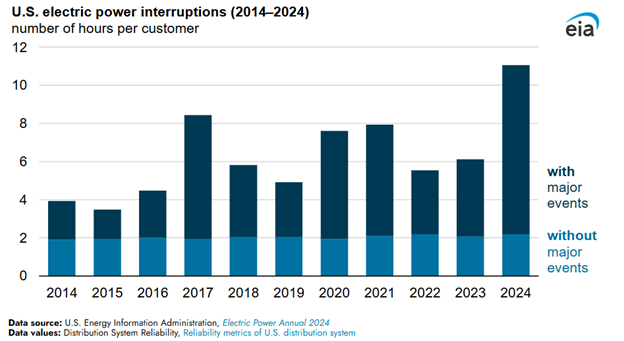
The light blue hours (without major events) have steadily increased, but the real increase is the dark blue (major events-Tornados, Hurricanes, Winter Storms). Tornados cause a narrow band of intense destruction to both electrical and non-electrical infrastructure, but a few miles away could be untouched making restoration quicker when compared to hurricanes.
When you think of storm related infrastructure damage, you of course think of Hurricanes. Hurricanes create widespread damage to all types of infrastructure and could result in weeks or even months of sustained power outages. The 2026 Hurricane season has been a complete dud due to strong El Nino winds that limit hurricane development over the Atlantic. Hurricanes have in general become stronger and more prevalent besides this year’s anomaly. You only must go back to 2024 for a particularly bad year with North Carolina and Floridia hit very hard.
Hurdles to Grid resiliency
Stronger storms and an aging grid are a bad combination. This doesn’t even factor in load growth. So, what are the hurdles to making the grid more reliant? There are many:
- Costs to update existing infrastructure- Utilities need to get approval from different entities to socialize the costs through captive ratepayers. These approvals are getting harder to get through as utility costs continue to grow.
- Increased load growth continues nationwide without adequate transmissions lines being built. This strains the existing grid causing more potential imbalances leading to outage.
- The Need for new Transmission is greater than updating the existing- While the existing infrastructure needs to be upgraded and modernized, the need for new transmission to account for future load growth is imperative. This requires an even more comprehensive approval process to acquire land costs, equipment that is in short supply and highly competitive, that needs to be socialized throughout the grid.
Last Week I attended the New England Roundtable that focused on transmission costs. In New England we have some of the highest transmission costs in the nation. With that cost though, comes greater reliability and the ability to re-route more power when multiple electricity lines are knocked out during storms. Utilities are focused on this type of reliability that adds cost to the rate base. The question is, where is the intersection between affordability and reliability? It’s getting higher, but so are the costs of future outages to the economy.
So How can Commercial, Industrial Manufacturers prepare?
Business leaders should start by assessing the cost of shorter outages: How would a power loss of a few hours affect production? Would partially completed product need to be discarded, or could operations resume once power returns? If production falls behind, how much revenue could be lost through waste, missed orders, or delayed fulfillment? If those costs are significant, your business may already have emergency generation in place for short-duration events.
The next question is how the business would withstand a longer outage one day, one week, or even a month. Those potential revenue impacts should be weighed against the cost of on-site generation or backup power. More end users are making these investments as outage risks become more frequent and severe.
Summary
The Grid needs new infrastructure built. Everything from High voltage Transmission lines to Voltage transformers, to acquiring land to create more pathways for future anticipated growth. Utilities are struggling mightily with that aspect-particularly the costs needed for said infrastructure and acquiring the land for that. Utilities are struggling to interconnect new loads onto an aging and increasingly full grid. That leaves no investment opportunities for upgrading the infrastructure in place. So yes, it’s going to get worse before it gets better.
With weather related outages on the rise, businesses that are particularly vulnerable to outages should benchmark short- and long-term outage costs. These should be weighed against onsite generation/backup power investments. If you need help accessing these risks verses investment, please feel free to reach out on email or phone.
Meet the Writer

Dileep Prabhakar
Freedom Energy Logistics
Regional Sales Director
Dileep Prabhakar, a Regional Sales Director at Freedom Energy since 2022, brings over 30 years of engineering and energy experience to his role. He has advocated for municipalities, school districts, and commercial and industrial customers, managing their energy procurement and sustainability initiatives while optimizing their energy spending and achieving decarbonization goals.





Connect With Us