
Day Ahead Ancillary Services (DAAS): Rising Costs and What It Means for New England Ratepayers
Authored by Carol Anne Watts | Vice President of Sales and Dan Cwalinski | Director of Contracts and Pricing
Day Ahead Ancillary Services (DAAS) has attracted growing criticism across the energy industry and has recently made headlines. Most notably, New Hampshire Governor Kelly Ayotte formally petitioned ISO New England to address the financial strain DAAS is placing on Granite State ratepayers¹. However, the impact is not limited to New Hampshire. Without reform and meaningful cost controls, residents across New England are facing significant rate increases. As program costs surged in late 2025 and into early 2026, suppliers serving load in the region began passing these higher expenses through to customers or increasing existing pass-through charges to reflect their rising cost to serve. As a New England ratepayer, you may already be seeing these increases reflected on your bill, and you may have options for how to respond or dispute them.
What is DAAS?
DAAS is an ISO New England administered market mechanism designed to procure operating reserves and other reliability services a day ahead of when they are needed. These services are intended to ensure sufficient generation and system flexibility are available to meet forecasted demand before real-time operations occur. While DAAS plays a critical role in maintaining grid reliability, the structure of the market has led to rapidly rising costs as reserve requirements expand and clearing prices increase.
What happened with DAAS?
To put things in perspective, ISO New England had forecasted DAAS to cost $139.9M annually. After $35.5M projected savings from the retirement of the Forward Reserve Market (which DAAS replaced), the net impact was expected to be $104.4M². In the first 11 months, DAAS costs exceeded $920 million. The highest costs were experienced in the week of Jan 26, 2026 through Feb 1, 2026, which alone were responsible for over $354M.
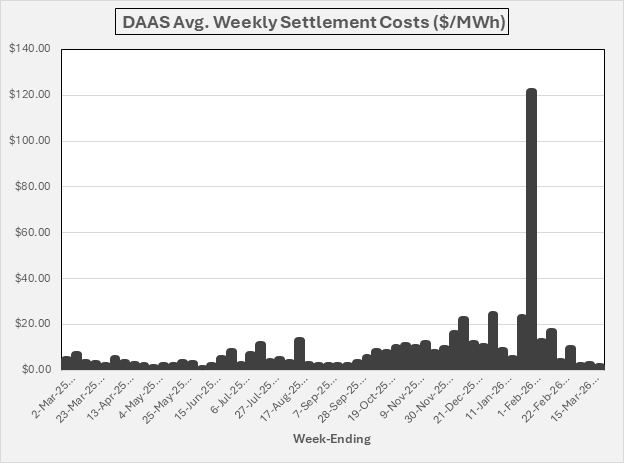
Suppliers incur DAAS costs as part of their wholesale settlement obligations with ISO New England, but anticipated costs were dwarfed by the real time settlements. As these costs increased materially, beginning in late 2025 and into 2026, many suppliers began:
- Passing DAAS costs through to end users
- Increasing pass through costs, for a second or third time, to reflect unplanned, heightened volatility
DAAS Timeline and Why it matters
The Federal Energy Regulatory Commission approved the Day Ahead Ancillary Services Initiative (DASI) on January 29, 2024. Following approval, minor, conforming tariff revisions were made to fully incorporate the program into the ISO New England tariff. However, the structure of the program itself has not changed since FERC's initial authorization.
As scheduled, ISO New England retired the Forward Reserve Market at the close of February 28, 2025, and formally implemented Day Ahead Ancillary Services (DAAS) on the same date.
If you have been impacted by increased costs tied to DAAS, understanding the timing of your supply contract is critical. For contracts executed prior to January 29, 2024, DAAS qualifies as a change in law event. At that time, suppliers could not have known whether FERC would approve or reject the program, making it difficult to price or hedge the risk in advance.
If your contract was signed between January 29, 2024 and February 28, 2025 and was marketed as an all-inclusive fixed price, it may be appropriate to ask your supplier for clarification. Specifically, customers should inquire why DAAS costs are being passed through and how those charges were calculated or anticipated during the pricing process.
For contracts executed on or after March 1, 2025 when DAAS went live, and marketed as fixed price products, there may be a stronger argument that incremental DAAS costs should already be embedded in the contract price. In these cases, customers should carefully review both the marketing representations and the contract language to determine whether pass-throughs are contractually justified.
Ultimately, both the timing of your contract and the specific language used in marketing and contractual terms will determine how DAAS costs should be treated.
References
[2] https://www.iso-ne.com/static-assets/documents/100007/er24-275-000.pdf
Meet the Writers

Carol Anne Watts
Freedom Energy Logistics
Vice President of Sales

Dan Cwalinski
Director of Contracts and Pricing
Freedom Energy Logistics
Dan Cwalinski is a seasoned energy professional with over 17 years of experience in the natural gas and electricity markets. As Freedom Energy’s Director of Contracts and Pricing, Dan leads supplier negotiations, pricing strategies, and contracting operations, helping clients navigate complex energy markets.







Connect With Us