
Solar PV Trends: Federal Tax Credits Extended by Safe Harbored Assets
Authored by Byron Blankenhorn | Renewable Program Director
The Freedom Energy renewables team works directly with various solar photovoltaic (PV) project developers and end-use clients across various state and utility markets. There have been significant changes to federal tax policies that were part of the One Big Beautiful Bill Act (OBBBA) that was signed in summer 2025. We are monitoring how these changes are affecting the costs of installing solar PV assets and economic impacts for developers and end-users. We are also documenting the safe harboring techniques being utilized to continue the monetization of the Investment Tax Credit (ITC), which provides a 30% tax credit for the solar assets purchased for a project.
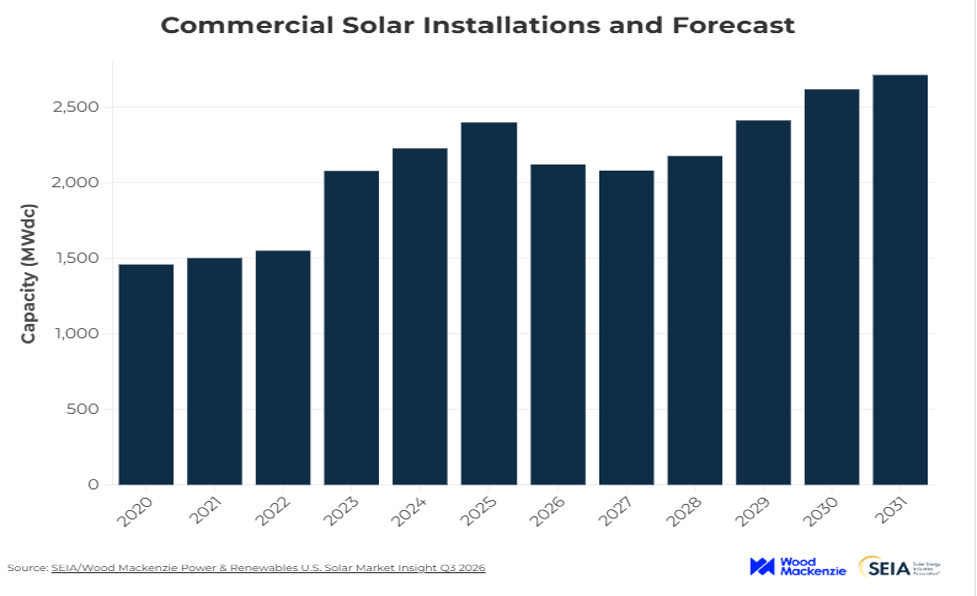
According to the Solar Energy Industry Association (SEIA) and Wood MacKenzie, the U.S. commercial solar PV market is projected to contract by 8% annually in both 2026 and 2027. This market contraction is being driven by the termination of the federal ITC for solar PV assets that was implemented in July of 2026. There has been significant confusion over the changes in federal tax crediting rules which have created challenges for both developers and end users. Smooth origination and deal execution for solar PV projects requires stakeholders to have a clear understanding of current tax rules and timelines. We are observing that the stakeholders who are utilizing safe harbored solar PV assets can monetize the 30% federal ITC and maintain attractive economics for their projects that are completed by the end of 2027. After this 2026 and 2027 solar PV slowdown, safe-harbored projects and retail energy rate increases expected to propel commercial solar market expansion through 2031.
Safe Harbor Assets and Federal ITC – How Does It Work?
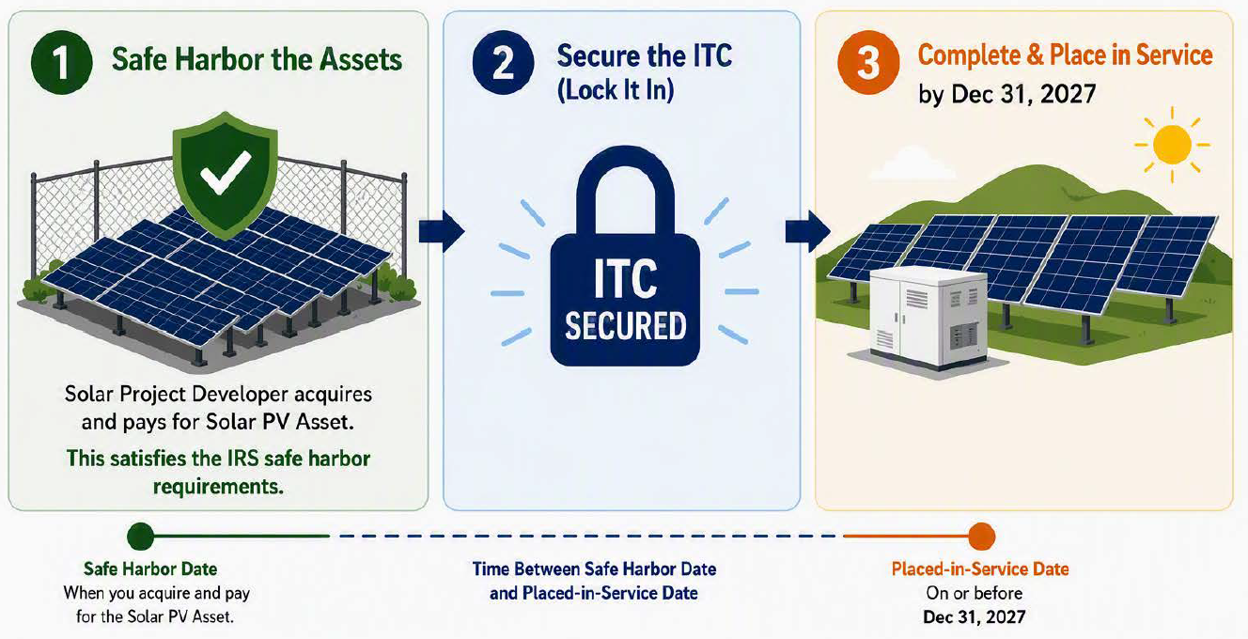
The One Bill Beautiful Bill Act accelerated the termination of the ITC for solar and wind projects to July 4, 2026. However, there were specific statutory provisions that allowed for projects developed after this date to still qualify for the ITC 30% tax credit. One key provision is the 5% Safe Harbor Test.
5% Safe Harbor Test (Internal Revenue Code §48E(e)(4) establishes that incurring at least 5% of total project’s cost allows for the project to qualify for the federal ITC.
What does this mean in practice? Many renewable energy project developers and equipment manufacturers took strategic positions on key qualifying assets before July 4, 2026, tax credit expiration deadline. The oversimplified explanation is that these firms filled warehouses with solar panels, inverters, and other key assets so that their projects pass the safe harbor tests and will still qualify for the federal ITC. This has allowed for many projects currently being proposed and developed to qualify for the 30% federal tax credit. Projects do need to be placed in service before December 31, 2027, to qualify for the tax credits, but this provides ample time for construction and integration for most retail sized solar projects – less than 1.5 MW.
Strategy and Predictions for 2026-2031+
The current 2-year strategy for the Freedom Energy renewables team is working closely with solar PV project developers who have safe harbored assets and can provide projects with economic advantages to end users. Our goal is to provide clarity and confidence in the project execution process and deliver great value projects to our clients.
We think it is important to articulate that the overall five-year forecast for solar PV shows growth after 2027. The commercial segment is expected to contract in the next two years on average by 8% but will be followed by accelerated growth from 2028 through 2030. Developers are motivated to energize safe-harbored projects before their four-year window expires. By 2031, rising retail electricity rates will serve as the dominant driver of the commercial solar market
Please contact the Freedom Energy team if you would like to learn more about solar PV and how it could work for your organization.
References:
SEIA – Solar Market Insights Q3 2026
Wood Mackenzie. “The State of Safe Harboring: A Strategic Outlook for US Utility-Scale Solar Development.” April 1, 2026.
Meet the Writer

Byron Blankenhorn
Freedom Energy Logistics
Renewable Program Director
Byron Blankenhorn brings over 20 years of global sustainability and energy market expertise to his role as Renewable Program Director at Freedom Energy Logistics. He leads renewable program strategy and development across the company’s portfolio, helping clients navigate clean energy procurement and carbon reduction pathways.





Connect With Us