
September 2026 NH Muni Minute
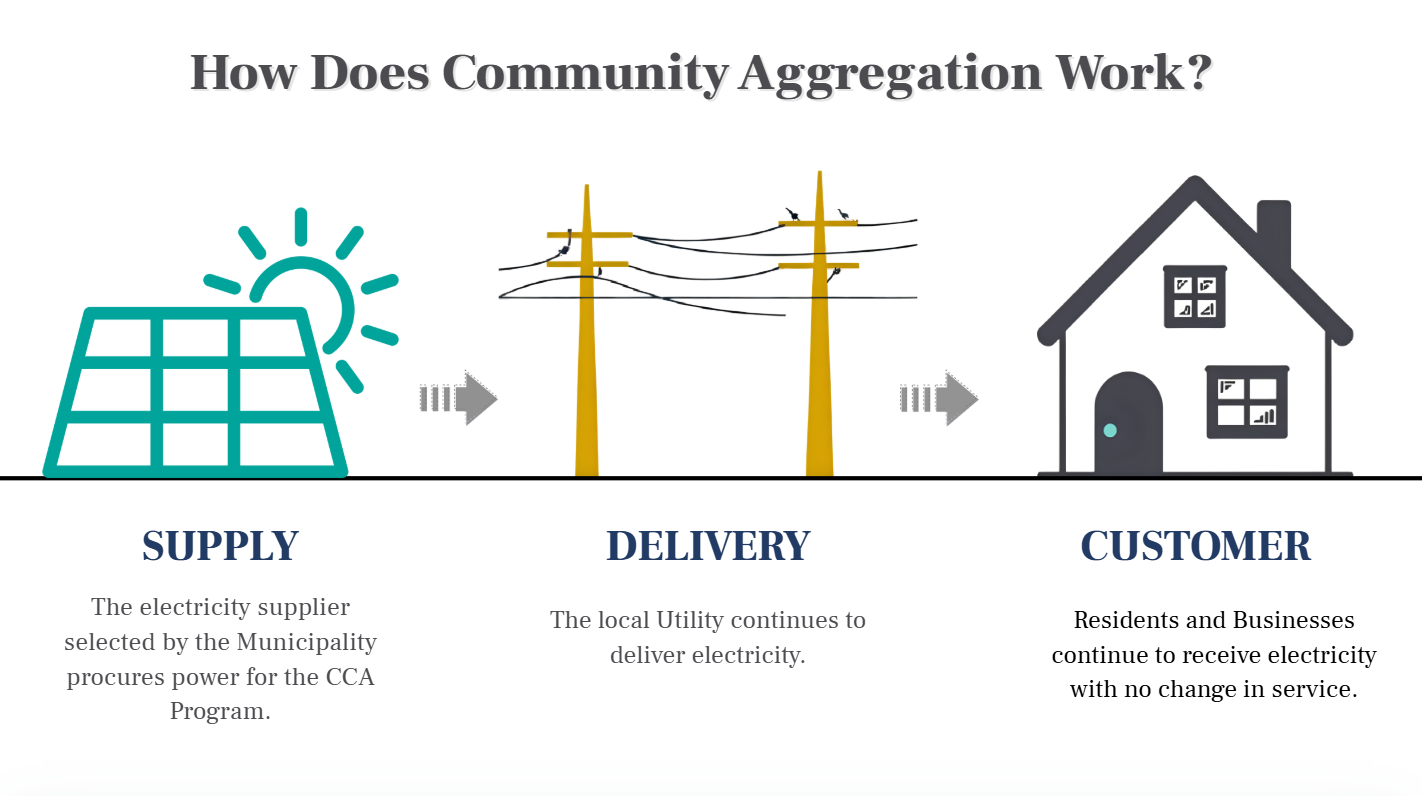
Community Choice Aggregation lets a town pool the buying power of residents and small businesses to secure competitive electricity rates, while the local utility keeps handling service and billing as usual. Towns have a few ways to do it, and the differences come down to who controls the decisions.
| Freedom Energy's Approach | Other Approaches (General) | |
|---|---|---|
| Suppliers | Multiple suppliers bid competitively | Often a single supplier |
| Local control | Town picks rate structure, term, and renewable options | Often a uniform, one-size-fits-all program |
| Contract length | 6 months to 5 years, timed to market conditions | Often fixed, shorter purchase cycles |
| Community fund | Optional adder (e.g., $0.001/kWh) for a local energy fund | Reserves, if any, may be pooled or used elsewhere |
Results cited by Freedom: Through September, Freedom has saved five recently launched CCA communities more than $4 million collectively.
Contact Us to learn more about our CCA offerings

Natural gas markets stayed quiet this summer, but the fundamentals are moving. Marketed production is projected to average 122.5 Bcf per day by year-end, topping 2025’s record of 118.5. Demand is rising too, driven by power generation, data centers, and record LNG feedgas, which averaged 18.9 Bcf per day for the week ending September 13.
Storage stands at 3,298 Bcf, 3.6% below last year but 3.8% above the five-year average.
Then there’s El Niño, possibly a “super” one. Milder northern winters would lower heating demand and soften regional spot prices. But less snowfall can mean weaker hydroelectric output, which pushes gas demand up. Futures haven’t dropped on El Niño talk, and the 12-month strip and winter basis remain elevated.
Bottom line: spot prices may ease, but forward markets could stay volatile heading into summer 2027.
To read the entire article click here.

June through August spot electricity prices averaged 5.3 cents per kWh, the second highest summer in the past ten years. Prices peaked at 47 cents at 5 PM on July 2 and bottomed at 0.5 cents, with no negative-price hours this summer. Natural gas spot prices stayed steady, with brief spikes to $10 to $12 per dekatherm on the hottest days.
Day-Ahead Ancillary Services prices averaged 0.21 cents per kWh, down from 0.44 cents last summer, possibly reflecting the first of three reforms.
Looking forward, 2027 electricity futures reached 8.25 cents per kWh as of September 11, above the 7.64 cent high from fall 2022. Oil price swings tied to the Iran war are driving volatility, especially for January and February. Futures for 2028 and 2029 trade well below 2027 but are also trending up. Meanwhile, gas futures are at a 4.5-year low, so electricity and gas prices continue to diverge.
To read the entire article click here.

New England’s 2026 system peak is very likely behind us: 25,303 MW on July 2 at 7 PM, which would rank as the 11th highest since 2001. Temperatures reached 95 to 100°F across much of the region. Behind-the-meter solar contributed roughly 6,500 MW midday, up from about 6,000 MW last year.
Only two curtailment notices went out this season, on July 2 and 3. July 3 peaked lower, at 24,358 MW, but we issued a notice because demand can exceed forecast on the second or third day of a heat wave.
Why it matters: the peak hour sets each account’s capacity tag for the following June 1, which drives capacity costs for 12 months. Curtailing between 4 and 7 PM on peak days can lower those costs. With fall here, a higher peak is increasingly unlikely, though winter load is growing in importance.
To read the entire article click here.

ISO New England’s Day-Ahead Ancillary Services Initiative (DASI/DAAS) has produced higher-than-expected charges, making budgets harder to predict for municipalities.
Two Massachusetts municipal clients recently disputed supplier-imposed DAAS increases that pushed their contracted rates well above the agreed pricing. After reviewing contract terms, documenting the issue, and working directly with suppliers, Freedom Energy restored their original rates and secured refunds for charges that should not have been assessed. Combined, the municipalities avoided more than $650,000 over the life of their contracts.
Every contract is different, but the lesson is clear: review your DAAS-related charges and the contract language behind any rate adjustments. If your municipality has questions, we offer a complimentary review.
To read the entire article click here.

Most energy buyers wait for a contract to expire, then request pricing. It’s a familiar routine, but it means accepting whatever the market looks like on that particular day. The best opportunities often come earlier.
Right now, New England’s forward power market is backwardated. Power for 2028 and 2029 is trading below many nearer-term delivery periods, which is unusual, and it comes while demand is growing from electrification, data centers, and economic development. Winter is the bigger concern. Solar has eased summer peaks, but few resources are being built to strengthen winter supply, so today’s forward prices may not fully reflect that risk.
Clients are acting on it:
- Salem, NH hedged 50% of its 2027 CCA load well ahead of the traditional procurement window. Since then, market prices have risen by more than a cent per kWh.
- Epping SAU signed in October 2024 for a December 2027 start, more than three years before delivery, and avoided major market moves since. The district recently committed to a new agreement covering 2027-2029.
- South Essex Sewerage District secured power for 2025 in early 2024, then came back this summer to buy 2028 delivery.
As Bart Fromuth puts it, the greatest procurement opportunities rarely occur when a contract expires. They occur when the market offers value.
Early renewal isn’t only about savings. It’s also budget certainty. For towns, school districts, and utilities planning years ahead, knowing a major operating cost in advance makes budgeting easier and reduces exposure to surprises, and that has value even if the purchase doesn’t hit the absolute low point.
No strategy is perfect. Markets can move lower after a contract is signed, and hindsight will always show a better moment. The goal isn’t to predict the market. It’s to act when the odds are favorable relative to the risk. That doesn’t mean locking in every opportunity, but every opportunity deserves evaluation.
To read the entire article click here.

Community Choice Aggregation lets New Hampshire municipalities buy electricity for their residents and businesses, with strategies that reflect local priorities rather than relying solely on utility procurement.
Laconia, Londonderry, Merrimack, Salem, and Windham have already taken this path. Salem in particular used a longer-term, flexible strategy instead of short-term agreements and to date has realized significant savings for its residents.
The takeaway: with CCA, energy procurement becomes an active, market-aware process instead of a routine administrative task.
🎙️ Coming Soon: The Freedom Energy Podcast
Why do timing and strategy matter more than the rate alone? In our upcoming episode, host Dileep sits down with Nick Shostak to talk about how towns can use contract timing, competitive bidding, and local oversight to manage energy costs. They also highlight Salem’s CCA program.

Forecasters are watching for a strong El Niño, and NOAA (National Oceanic and Atmospheric Administration) is projecting a milder-than-average winter across much of the northern U.S. Historically, that can translate into lower heating demand and softer regional energy prices, particularly when temperatures remain moderate through the core winter months.
However, a mild winter overall does not eliminate the risk of short, intense cold snaps. Last winter, oil became the marginal fuel for several days during periods of tight supply, highlighting how quickly New England’s fuel mix can shift when natural gas availability is constrained. That risk is already showing up in January and February electricity futures, which continue to track movements in oil and other fuel markets.
Snowfall is another factor to watch. Less snow can reduce hydroelectric generation, potentially increasing reliance on natural gas and other fuels for power generation. That added demand can put further pressure on regional gas and electricity prices during periods of cold weather.
So, even with a mild-winter forecast, forward markets have not fully priced in relief. For New England energy buyers, the takeaway is that planning for price volatility remains important, even when the broader seasonal outlook looks favorable.
In an op-ed published in the New Hampshire Bulletin on August 31, 2026, Bart Fromuth, CEO of Freedom Energy Logistics, argues that New Hampshire’s energy squeeze is real but not inevitable.
The problem. Rising electricity and fuel costs are straining household budgets and thin business margins. Global instability affects fuel supply and pricing, and New England’s rigid energy structure limits how well the region can respond. Utilities typically buy power in six-month blocks, which limits their ability to take advantage of favorable markets and leaves ratepayers with little protection when prices spike.
The municipal solution. Community Choice Aggregation lets towns take a more active role in buying energy for their residents and businesses, with strategies that reflect local priorities and market opportunities. Laconia, Londonderry, Merrimack, Salem, and Windham have already taken this path. Salem is the clearest example. Rather than lock into short-term agreements, it pursued a longer-term, flexible strategy, and it is projecting savings of more than $825,000 in just the first few months of the program. Bart’s point is that procurement stops being a routine administrative task and becomes an active, market-aware process.
The “third path.” Bart also calls for an all-of-the-above approach that moves past the either-or debate between traditional fuels and renewables, or between cost and sustainability:
- Keep expanding renewables, backed by storage and grid modernization
- Maintain access to reliable domestic sources like natural gas, especially for peak demand and winter
- Update net metering so incentives reflect the needs of the grid as a whole
The bottom line. By empowering municipalities, embracing flexible procurement, and pursuing a balanced energy portfolio, the state can build a more resilient system that protects residents and businesses from future price shocks.
To read the entire article click here.

Freedom Energy Logistics at NHMA's 85th Annual Conference & Exhibition
Freedom Energy Logistics is looking forward to attending the New Hampshire Municipal Association's 85th Annual Conference & Exhibition.
On October 28–29, our CEO Bart Fromuth, Regional Sales Director Thomas Carter and Account Executive Nick Shostak will be available to connect with attendees and discuss the evolving energy landscape across New Hampshire. Our team is excited to engage in meaningful conversations around Community Choice Aggregation (CCA), Net Metering, and other timely energy topics shaping the state's energy future.
If you're attending, be sure to stop by our booth to meet the team and explore collaborative opportunities that support local NH communities.

At 6 a.m., the streets of downtown Manchester started to look like 1975. Hundreds of vintage vehicles rolled toward their display spots for the 25th Annual Manchester Rotary Club Car Show, windows down and owners grinning behind the wheel.
This year's theme, "Cruising for a Cure," supports leukemia awareness and stem cell donation for local children and families. The show stretched from the Bridge Street Bridge, closed to traffic and lined with muscle cars high above the Merrimack, into the historic Elm Street district. Food trucks, live music on a street-level stage, and plenty of dogs kept the atmosphere lively.
Two standouts: a 1970s Ford Country Squire station wagon, complete with wood paneling and rear-facing seats made for family road trips, and a Chevy Scottsdale pickup whose blue interior matched its exterior, with an eight-foot bed that would be a challenge to park today.
Not a car person? Come for the pups, the food, and the conversation. It's community at its best, and we're already looking forward to next year.
Read the entire article click here.
Energy prices rarely move for just one reason. Global fuel markets, weather, infrastructure limits, policy, and rising demand all shape what towns and residents end up paying, and a lot of it is outside local control.
What’s changed for buyers
- Fixed isn’t always fixed. New ancillary service costs in the ISO New England market (DASI) can exceed 10% of the retail energy rate and swing with weather and season.
- Comparing bids is harder. The rate on the contract is no longer always the rate you pay, so an apples-to-apples comparison takes a closer look at contract language and pass-through terms.
What it means for a municipality
- Affordability is now less about the lowest rate and more about strategy: timing, contract structure, and risk tolerance.
- The goal isn’t to predict the market. It’s to build a plan that holds up when conditions change and keeps budgets stable.
- Knowing your numbers and forward costs leads to better-informed buying decisions.
Watch Freedom’s podcast: Energy Affordability







Connect With Us